Starting Solids at 6 Months: What to Offer in the First Week
Is your 6-month-old ready for solids? Readiness signs, first-week foods, texture, amounts, timing, and what to hold off until 12 months.
In short
- Solids start at about 6 months, when your baby can sit with a steady head, bring food to their mouth and swallow it.
- In the first week, offer one single-ingredient new food at a time and leave 3 to 5 days between new foods.
- Start with half a spoonful to a few teaspoons, once a day. Breast milk or formula is still the main source of nutrition.
- No honey and no cow's milk as a drink before 12 months; no added salt or sugar in the first year.
- Call your doctor about swollen lips or face, a rash or vomiting after a new food; call emergency services for breathing trouble.
You hold out the spoon; the mouth opens, then the first taste comes straight back out, followed by a wrinkled nose. That is an ordinary first day. The short answer: in week one, one or two single-ingredient foods, once a day, a few teaspoons at a time. Below: readiness signs, texture, timing and the foods that have to wait.
What changes at 6 months?
The World Health Organization (WHO) says around 6 months a baby's need for energy and nutrients starts to exceed what breast milk provides, and babies are developmentally ready for other foods. The NHS, the CDC, the American Academy of Pediatrics (AAP) and Türkiye's Ministry of Health land on the same point: solids start at about 6 months. Breast milk or formula stays the main drink through the first year.
The calendar is not the only test. The NHS lists three signs that, together from around 6 months, show a baby is ready:
- They can stay in a sitting position and hold their head steady.
- They can coordinate eyes, hands and mouth: look at food, pick it up and bring it to their mouth.
- They swallow food rather than push it back out.
Chewing fists, waking more than usual at night or wanting extra milk feeds are normal baby behaviour, the NHS says, not signs of readiness on their own. If your baby was born prematurely, agree the start date with your doctor.
What to offer in the first week
The CDC, citing the AAP, says most children do not need foods in a certain order. The shared rule is one single-ingredient new food at a time, with 3 to 5 days between new foods (the CDC, the AAP and Türkiye's Ministry of Health agree). So the first week means one or two new foods.
Options the sources name for this age:
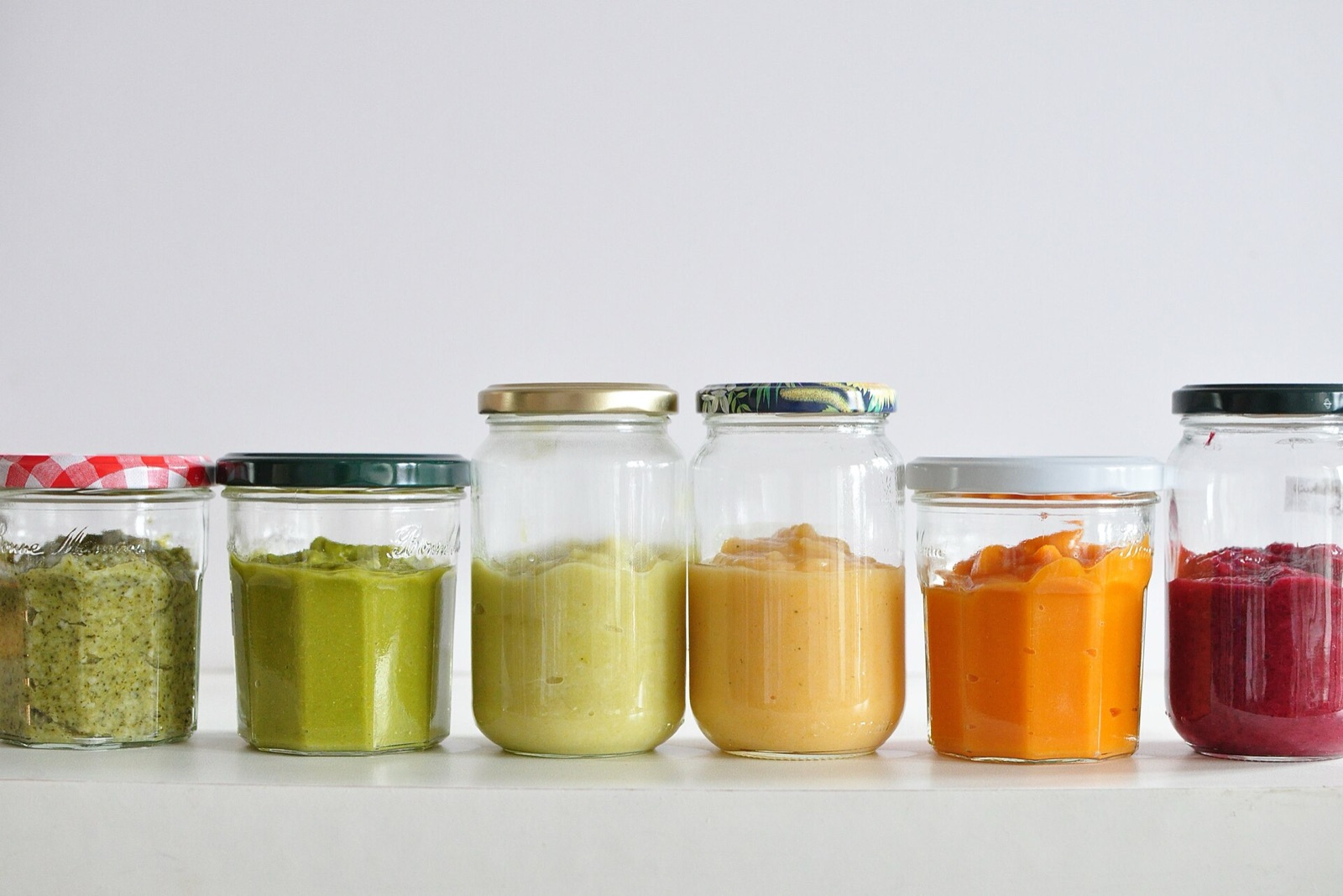
- Vegetable purée: Carrot, potato, sweet potato, parsnip, broccoli, cauliflower or spinach, cooked until soft, then mashed or blended. The NHS suggests including ones that are not sweet, such as broccoli and cauliflower.
- Plain yogurt: Full-fat, pasteurised, with no added sugar.
- Fruit purée: Apple and pear are cooked and mashed; banana can be mashed raw.
- Iron-fortified infant cereal: Oat, barley or multigrain, mixed with breast milk, formula or water.
Texture. WHO lists puréed, mashed and semi-solid foods from 6 months and says most infants can also eat finger foods by 8 months. The CDC notes that very smooth textures are easier at first; the AAP suggests diluting food the first few times, then gradually thickening it. The NHS encourages moving on to mashed, lumpy and finger foods as soon as your baby can manage them. Some families start with soft finger foods, and the NHS says there is no right or wrong way.
Amount. The AAP suggests starting with half a spoonful or less, staying at a teaspoonful or two in the early days and increasing gradually. The NHS says "just a few pieces, or teaspoons of food". How much your baby eats matters less than getting used to the idea of eating.
How often. The NHS says that to start with, a small amount once a day is enough. WHO and Türkiye's Ministry of Health describe 2 to 3 meals a day for 6 to 8 months; you build up to that step by step.
Time of day. The NHS's test is a time when you are not rushed and your baby is not too tired. Türkiye's Ministry of Health advises daytime hours, when the baby is hungry. The NHS offers solids before the usual milk feed but before your baby gets too hungry; the AAP suggests a little milk first, then the spoon. What they share: not starving, not full.
Water. The NHS says you can offer sips of water from an open cup with meals from around 6 months. The upper limit differs: the AAP says no more than 1 cup (8 ounces, about 240 ml) a day, while Türkiye's Ministry of Health allows 1 to 2 glasses of boiled, cooled water for the 6 to 12 month period.
Schedules differ for allergenic foods such as egg, fish and peanut. The NHS says they can be introduced from around 6 months, one at a time and in small amounts, with peanuts finely ground or as nut butter, never whole. The AAP says there is no evidence that delaying them prevents food allergy. Türkiye's Ministry of Health is more gradual: a quarter of an egg yolk at 6 months, a full yolk plus meat and fish at 7 months, and whole egg at 8 months. Decide with your doctor which schedule to follow.
A sample first week
This is an example, not a rule.
| Days | New food | How |
|---|---|---|
| 1-4 | Carrot purée | Once a day, in the daytime. Start with half a spoonful, go up to a teaspoon or two if your baby wants more. |
| 5-7 | Plain yogurt | Once a day, in the daytime. A few teaspoons. |
Milk feeds carry on as usual. Noting which food you tried on which day makes the 3 to 5 day gap easier to keep; if you use RADLE, add it to the solid food log.
What stays off the plate this month
- Honey: Not in any form before 12 months, because of the risk of infant botulism. Do not add it to food, water or formula, or put it on a pacifier.
- Cow's milk as a drink: Not before 12 months, say the NHS and the CDC. Yogurt, cheese and milk used in cooking are separate; the NHS allows milk in cooking from around 6 months. Türkiye's Ministry of Health writes that small amounts can begin after 8 months as long as it is not the main drink, without saying how to give it. Unless your doctor says otherwise, do not give it as a drink before 12 months.
- Salt: No salt is added to a baby's food in the first year. That rules out stock cubes, ready-made soups, canned and brined foods and processed meats such as sausage and salami.
- Sugar: Türkiye's Ministry of Health does not recommend sugar or foods with added sugar in the first year.
- Fruit juice: The AAP and the CDC say none before 12 months and WHO advises limiting it, while the Turkish Ministry's 6-month list includes fruit and vegetable juice. The common ground is the fruit itself as a purée; ask your doctor about juice.
- Tea, coffee and sugary drinks: WHO advises avoiding these low-nutrient drinks.
- Choking hazards: Whole nuts (the NHS says not before age 5), whole grapes, and hard raw pieces such as raw carrot and raw apple. Small round foods like grapes and cherry tomatoes are cut into quarters.
Common mistakes
- Expecting solids to fix sleep. The NHS says starting solids will not make your baby more likely to sleep through the night.
- Adding baby cereal to the bottle. The AAP advises against it because of the choking risk. With reflux, that is the doctor's decision.
- Giving up after the first refusal. Getting used to a new taste or texture can take 10 tries or more.
- Pushing to finish the bowl. A firmly closed mouth or a turned head means "enough". Do not force it; try again next time.
- Cutting back on milk. Most of your baby's energy and nutrients still come from breast milk or formula.
- Mistaking gagging for choking. Gagging is loud: eyes water, the tongue pushes forward, your baby may retch or vomit. Choking is quiet. Stay with your baby for the whole meal.
When to call the doctor
Ask before you start: If your baby was born prematurely, has a diagnosed food allergy or eczema, or there is a family history of food allergies, eczema, asthma or hay fever. With severe eczema or an egg allergy, ask specifically about peanut-containing foods.
Call your doctor after a new food: If you see swollen lips or face, a red itchy rash, vomiting, diarrhoea, wheezing or coughing, talk to your doctor before offering that food again. The NHS says reactions usually start within a few minutes but can take up to 2 hours to appear. In some allergies, such as milk allergy, it can take up to 3 days.
Call emergency services right away (911 in the US, 999 in the UK, 112 in the EU and Türkiye): Breathing problems, a swollen throat or tongue, or a raised itchy rash that comes on quickly can signal a severe allergic reaction (anaphylaxis), which is a medical emergency.
If you think your baby is choking: A baby who goes quiet, cannot breathe properly, and whose skin, gums or inner lips start to look blue may be choking. The NHS sequence: shout for help, get them out of the high chair and start back blows, then chest thrusts if those do not work (the NHS page in the sources shows how). If the blockage does not come out, call emergency services and keep going until help arrives. Even if it comes out, get medical help.
Also ask your doctor: If stools become very loose, watery or full of mucus, the AAP suggests reducing solids and going more slowly; if it continues, do not wait for the next check-up. Ask too if you worry your baby eats too little or too much, and about vitamin D and iron supplements.
The goal of week one is an introduction, not a full tummy. Half a spoonful of purée and a scrunched-up face is exactly the start it should be.
Sources
- Complementary feeding World Health Organization (WHO)
- Bebek Beslenmesi T.C. Sağlık Bakanlığı, Halk Sağlığı Genel Müdürlüğü
- Your baby's first solid foods NHS
- From around 6 months - Feeding your baby NHS Best Start in Life
- Foods to avoid giving babies and young children NHS
- Food allergies in babies and young children NHS
- Choking and gagging on food NHS Best Start in Life
- How to stop a child from choking NHS
- When, What, and How to Introduce Solid Foods Centers for Disease Control and Prevention (CDC)
- Foods and Drinks to Avoid or Limit Centers for Disease Control and Prevention (CDC)
- When Can Babies Start Solid Foods? Readiness & Feeding Tips American Academy of Pediatrics (HealthyChildren.org)